
Which Dalton Records Are Open
Georgia law favors access to agency records, but access depends on the record and its custodian. Dalton administrative files may be requested from the city. Whitfield County offices maintain the durable land, court, probate, tax, and custody trails. Georgia agencies keep vital certificates, correctional records, corporations, and professional licenses. An open index is often free to search, yet the underlying image, pleading, decree, or certified certificate may follow different rules.
| Dalton record set | Responsible custodian | Online reach | Practical access |
|---|---|---|---|
| Deeds, liens, plats, UCCs | Whitfield Superior Court Clerk | Current search; separate 1852–1970 index | Public index and clerk copy request |
| Superior and probate cases | Superior Clerk or Probate Court | Current and record-specific portals | Index, counter, phone, or copy order |
| Property and tax roll | Whitfield Assessor/GIS | Current parcel, owner, and address search | Free web portal; office fallback |
| Dalton city and police files | City department or Open Records Officer | Forms and limited report request routes | Web, email, mail, or counter |
| Birth and death certificates | Georgia DPH or local vital office | No open name index; state scope from 1919 | Eligibility, ID, application, and fee |
| Jail, state custody, registry | Sheriff, Georgia DOC, or GBI | System-specific current searches | Free search or phone; verify in court |
Juvenile and adoption files, sealed cases, protected victim details, motor-vehicle personal data, and confidential vital information do not become open merely because a request is filed. Agencies should redact exempt fields when feasible and release the rest. Voter information has its own public and protected split, covered in detail under Dalton voter registration records.
Dalton Deeds Span Two Portals
Whitfield County’s historic land index is unusually deep. The QuickLink deed system covers index books from 1852 through 1970, a 119-year run. It offers year bands for 1852–1954 and 1955–1970, surname and first-name fields, an index-book search, and volume-and-page browsing. Volumes run through numbered books as well as lettered volumes. The site points searches from 1990 forward to GSCCCA. The precise home for 1971–1989 remains unverified, so call the clerk instead of assuming that gap is absent.
A name in an index is a pointer, not the whole deed. Use the party role, date, instrument type, and book/page to separate people with similar names. Then ask whether the image is online or must come from the clerk. A recording-fee schedule does not establish the price of a plain or certified copy.
- Grantor
- The person or entity transferring an interest.
- Grantee
- The person or entity receiving that interest.
- Index
- A finding aid that points to a recorded instrument.
- Certified copy
- An official copy authenticated by the custodian.
Note: A courthouse fire does not mean every early Whitfield record vanished; surviving deed and probate series begin in 1852.
Dalton Property Records Split Addresses
The Whitfield Tax and GIS search accepts an owner name, parcel number, realkey, or property address. Its parcel detail separates the owner’s mailing address from the parcel address, also called the situs address. That distinction matters. A distant mailing city may belong to a nonresident owner, a representative, a post-office box, or an older tax contact. It is evidence, not proof of where someone now lives.
| Portal field | Input type | How to use it | Result path |
|---|---|---|---|
| Owner Name | Text | Try surname first and spelling variants | Owner and parcel matches |
| Parcel Number | Text | Use the county’s hyphenated format | Exact parcel detail |
| Realkey | Numeric text | Enter the internal parcel key | Exact parcel detail |
| Property Address | Address parts | Normalize street suffixes | Situs matches |
| Property Record Card | Result link | Open assessment and building details | Detailed card |
| GIS Map | Result link | View parcel geography and map layers | Mapped context |
The visible record can include the legal description, subdivision and lot, tax district, acreage, value, appeal status, and coordinates. Use its book/page or legal description to move from the tax roll to the deed system. The chain is simple: parcel result to deed reference to recorded instrument. If a historic assessment is not online, request the year-specific roll from the assessor.
Dalton Court Records Need Division
There is no single court box for every Dalton case. The Whitfield Superior Court clerk holds Superior civil, domestic, criminal, garnishment, adoption, and appeal files. Probate Court handles estates, guardianships, and marriage material. Magistrate Court handles its own civil matters, while Dalton Municipal Court covers city ordinance and qualifying traffic cases. Juvenile proceedings are restricted. Federal cases use PACER and the Northern District of Georgia.
The Whitfield Magistrate party search expects a name in LAST FIRST order, requires at least two letters, omits suffixes, and advises spelling variants. Filters include court code, division, filing-date range, and active or inactive status. An online docket is still not the filed pleading or certified disposition. Confirm a match by case number, date, type, and party role, then contact the correct court for copies.
Older or missing files call for a counter search. Ask whether a public terminal reaches scans or date ranges that the public web does not. Municipal requests should include the defendant name, citation or case number, an approximate date, and the document sought because no verified open party-name portal exists for that court.
Dalton Vital Records Limit Copies
Public facts about an event are not the same as a certified vital record. The Georgia Department of Public Health holds statewide birth and death certificates from January 1919. O.C.G.A. §31-10-26 limits birth-certificate copies to the registrant and people with an authorized family or legal interest. Certified death copies require a direct and tangible interest. Georgia publishes no simple rule that makes a modern birth certificate public after 100 years.
The first birth or death certificate costs $25, with $5 for an extra copy in the same order. An applicant supplies the current form, identification, payment, and relationship or interest. Use the address printed on the current application because state pages contain more than one agency address. State mail processing may take eight to ten weeks, and faster delivery does not speed the agency’s review.
Whitfield Probate Court is the local source for a marriage license or certificate. The state marriage search costs $10 and includes one certified letter if found, with same-order extras at $5. For divorce, DPH verification only confirms that an event was reported during its covered series. The signed decree and case file come from the Whitfield Superior Court clerk.
Eligibility comes first. An online application does not turn a restricted Dalton certificate into an open record. Use archives and library indexes for historical research.
Dalton Public Records Custodians
Send a request to the office that keeps the file. Dalton City Hall is not the general custodian for county deeds or court cases. Likewise, the Superior clerk cannot certify a state birth record. These contacts cover the main local channels, including in-person and phone fallbacks when a portal fails.
Whitfield Superior Court Clerk
205 N. Selvidge Street
Dalton, GA 30720
706-275-7450
Whitfield Probate Court
Whitfield County Courthouse
Dalton, GA 30720
706-275-7400
Whitfield Tax Assessor
201 S. Hamilton Street
Dalton, GA 30720
706-275-7410
Parcel and GIS lookup
Dalton Open Records Officer
300 W. Waugh Street
Dalton, GA 30720
706-529-2404
openrecords@daltonga.gov
The Dalton City Clerk page shows the city office that preserves minutes and documents from 1884 forward, plus annexation, campaign-contribution, and West Hill cemetery records.
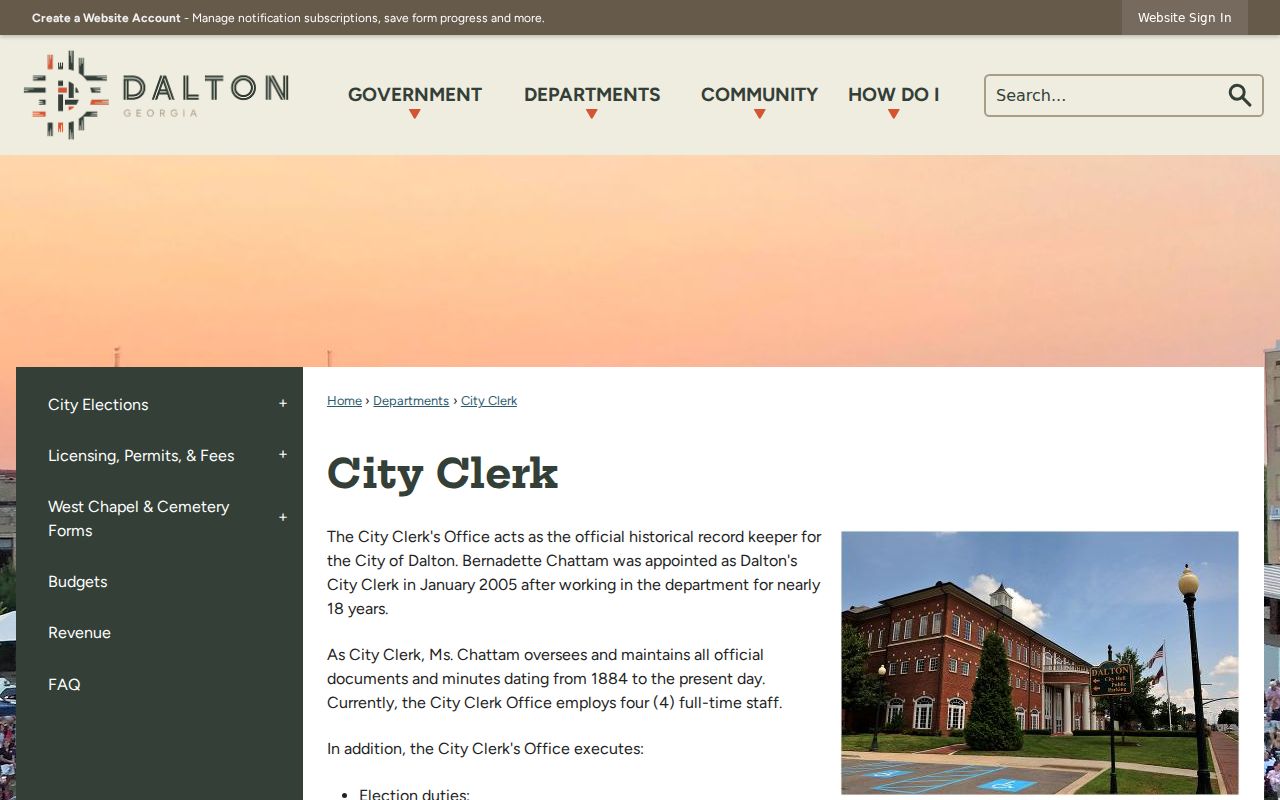
That city chronology creates a distinct name trail outside the county courthouse, especially for civic, boundary, and cemetery matters.
Dalton City Records Without Indexes
Many municipal files have no open name index. Dalton’s forms reveal records for occupational tax certificates, alcohol and mobile-food vendors, pawnbrokers, solicitors, boards and authorities, annexations, cemetery ownership, address signs, and building work. Request those records from the department that created them. Give a person or business name, property address, file type, and tight date range.
The city forms collection is the best starting point for identifying the right department and exact file name.
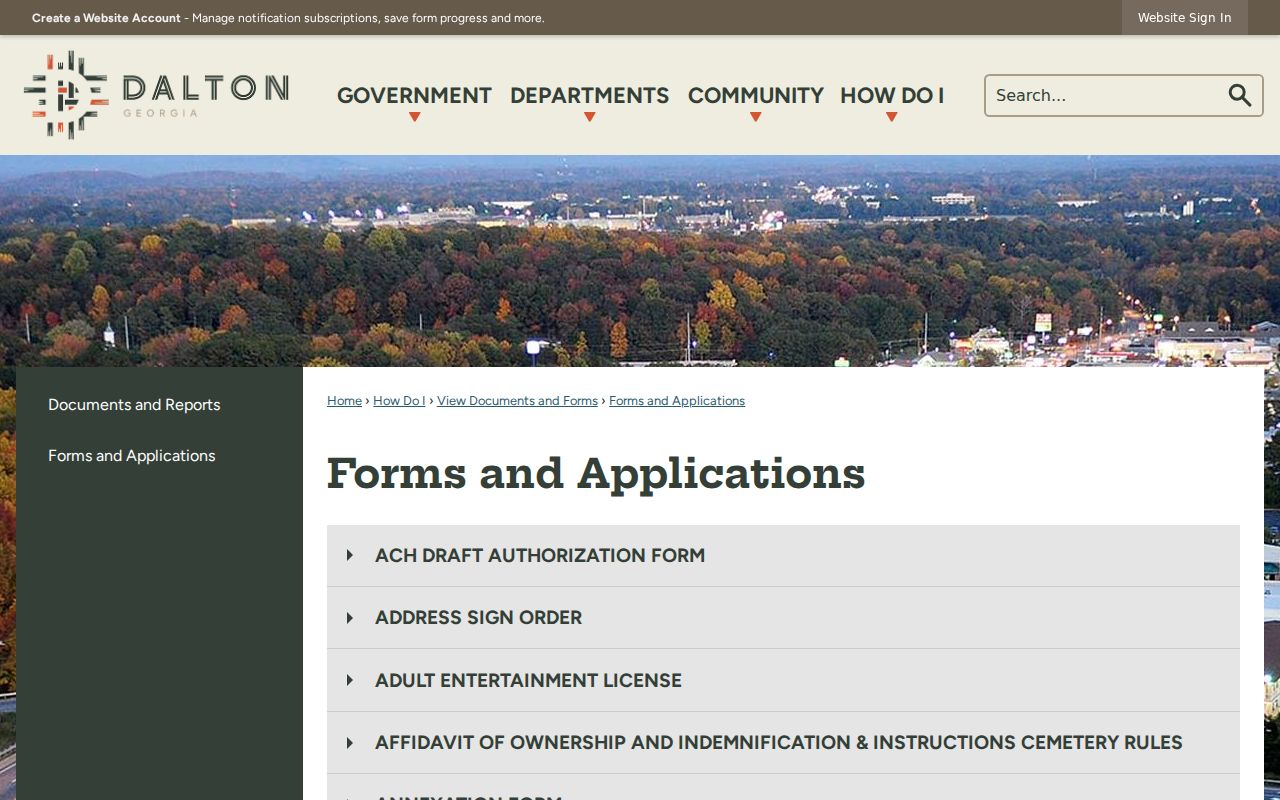
The forms do not prove that every submitted field is public. The custodian may redact protected data while releasing the rest of an existing file.
West Hill records illustrate why office choice matters. The City Clerk retains original cemetery deeds, which establish burial entitlement, but does not hold the separate burial database. When an original purchase cannot be located, cemetery staff can research purchase date, lot, block or section, and lot size before an heir signs an affidavit and pays the $35 replacement-deed fee.
Dalton Police Records Differ From Custody
A Dalton incident report, a Whitfield jail entry, a Georgia correctional result, and a registry entry describe different systems. The Dalton Police Records Section at 301 Jones Street accepts counter requests on weekdays from 8 a.m. to 5 p.m., excluding holidays. Bring the officer’s case number when possible. One or two incident reports are free under the stated policy; three or more require a formal records request. Accident reports are free for in-person pickup, while mailed reports take several days.
The Police Records Section explains the counter route, ID rules, and contact details.
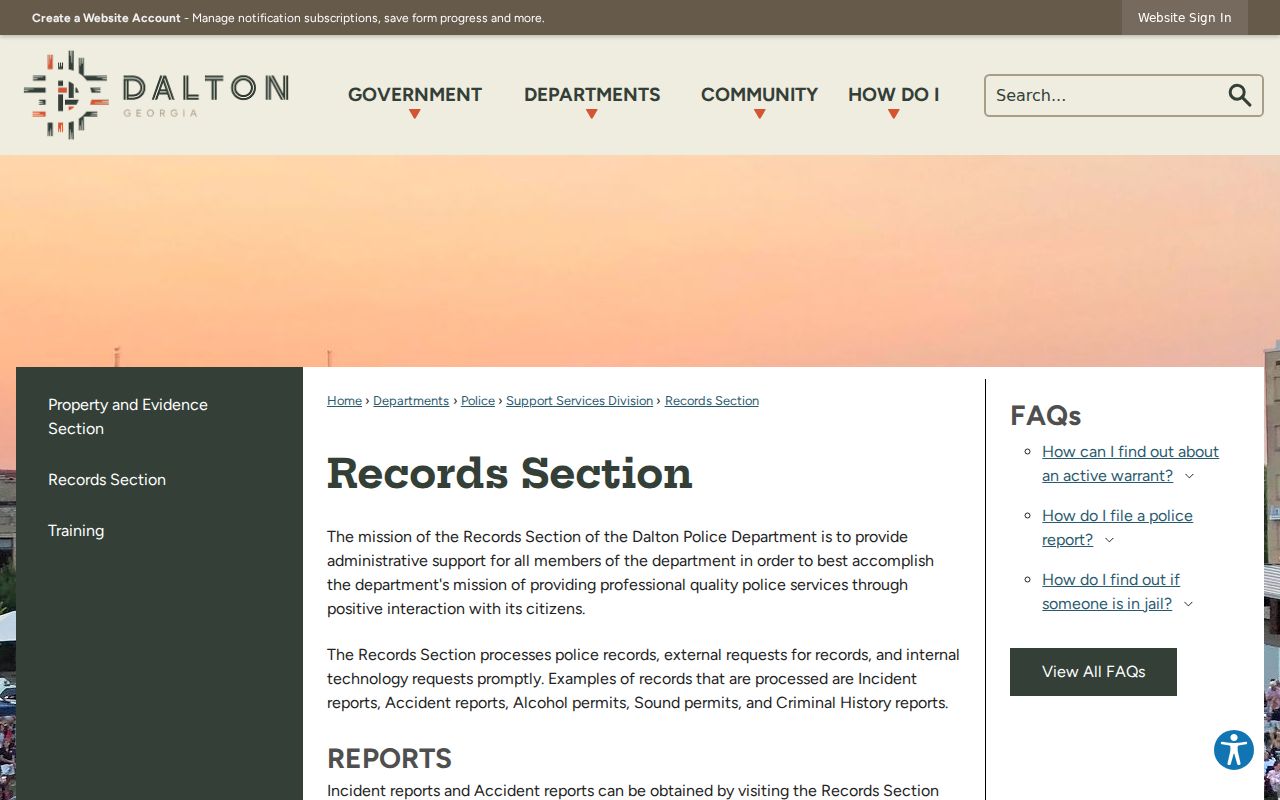
Its page helps distinguish a report-copy request from local or Georgia criminal-history service, which requires photo ID and signed consent.
The police report web form asks for requester contact data, an incident date and place, details, and an optional case number.
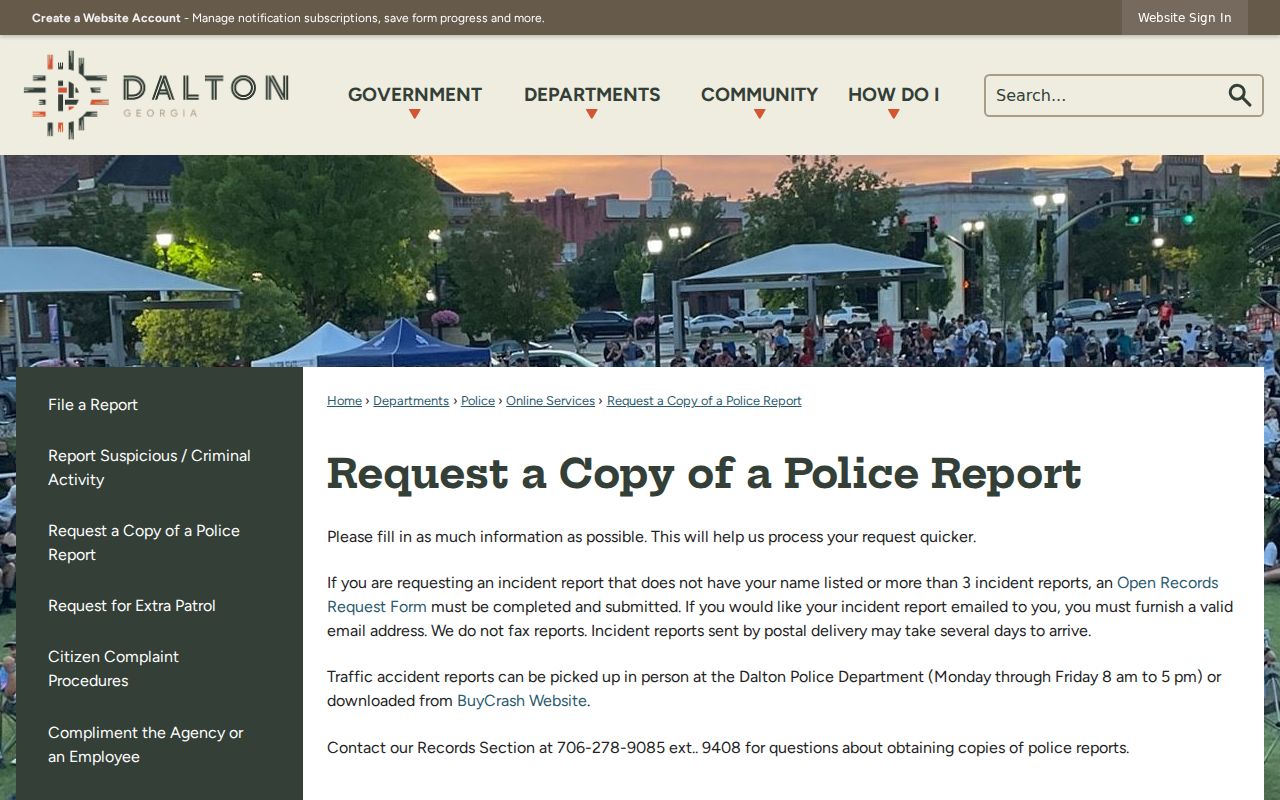
A requester who is not named in the report must use the city Open Records route. For current county custody, call the Whitfield Sheriff or use its current P2C route. Georgia DOC covers state correctional custody, and the GBI registry serves a separate public-safety purpose. An arrest or booking is not a conviction, so confirm the final disposition with the court.
Dalton Records Fees and Timing
The Georgia Open Records Act requires access within three business days when records are available. If not, the agency must provide a written timetable. It must also identify estimated costs and cite the precise Code provision for withheld material. Three business days is a response deadline, not a guarantee that a large search will be finished.
Under O.C.G.A. §50-18-71, ordinary letter or legal copies generally cost no more than ten cents per page. Electronic delivery should be used when practical. The first 15 minutes of search and retrieval time are free; later time is charged at the rate of the lowest-paid qualified employee. Actual media cost may apply. An agency may not charge for making a new report it has no duty to create.
This fee rule is one of the most useful Dalton records details. Ask for inspection or native electronic files, and narrow broad dates before staff begins work. Prepayment may apply to estimates over $500 or when prior lawful charges remain unpaid.
File a Dalton Records Request
A focused request saves time and reduces cost. Georgia does not require magic words. Describe an existing record rather than asking staff to research a person or create a summary. The city’s revised form offers separate choices to inspect and review records or obtain copies, and it accepts return by email or mail.
- Choose the custodian. Send deeds and Superior files to the clerk, probate material to Probate Court, property rolls to the assessor, and city files to the responsible Dalton department.
- Define the record. Supply names, address, case or parcel number, record type, and the narrowest useful date span.
- State the format. Ask to inspect, receive copies, or obtain the native electronic file when useful.
- Keep delivery proof. Save the email, receipt, or mailing record and note the three-business-day response period.
- Review any estimate. Proceed, narrow, or withdraw before costs grow. Ask which search terms or date ranges drive the estimate.
- Address a denial. Request the exact exemption citation and any reasonably separable, redacted remainder.
Lawful personal use. Public access is not permission to track, threaten, stalk, or harass anyone. Respect protected addresses and use official records for legitimate personal, family, property, or civic research.
Dalton Records Denials and Fallbacks
When a portal shows no result, do not treat absence as proof. Online coverage may begin late, a name may be indexed under a variant, or the file may exist only in a book, public terminal, archive, or department cabinet. Call the division, give the known identifiers, and ask whether the counter reaches older material. Georgia Archives, library collections, and county microfilm are sound fallbacks for inactive historical series.
If a Dalton agency withholds material, ask for its written citation to the exact statute, subsection, and paragraph. Also ask whether exempt fields can be removed so the remainder can be released. Preserve each message and cost notice. The Georgia Attorney General’s open-government guidance describes mediation, while superior-court enforcement and civil penalties may be available in a proper case.
A custodian need not compile facts or answer questions that require a new report. Recast that request around existing emails, applications, ledgers, dockets, maps, or database exports. That shift often turns an unworkable question into a precise records request.
Note: Confirm copy and certification prices directly with each Dalton or Whitfield office because filing and recording fees are not copy fees.